Who would think to turn an abandoned 115,000 square foot shopping center in New Jersey into an indoor amusement park and event center? Well, someone did and it's called "iPlay America" and it's in Freehold, New Jersey. This new twist on a family fun center includes an indoor boardwalk-style arcade and an indoor town. Other attractions include several themed restaurants, indoor go-karts and bowling.
What I find so encouraging about this project is that the developer used an existing site and building footprint to create a completely new business. Adaptive reuse at its best! We really need to start thinking about what to do with shopping centers and big box stores as they become obsolete or move to different buildings. These buidlings have an immense amount of embodied energy in them meaning it is very inefficient and costly to demolish them, especially if we can use the space adaptively for something new.
Can you think of any other adaptive reuse examples from New Jersey?
iPlay America: http://www.iplayamerica.com/
Friday, December 2, 2011

Monday, October 31, 2011
New Jersey Snowstorm: Planning Implications
by Marley Bice, MCRP '12
The apocalyptic snowstorm that dumped around three inches of slushy snow on the Northeast region over Halloween weekend got me thinking about implications for planning, our cities, our environment. Looking out my window at 10 am on Saturday (besides feeling like I was on the set of "The Day After Tomorrow") I found myself feeling so bad for the poor trees. Deciduous trees are not adapted to withstand wet, clingy, heavy snow on their leaves. The combined excessive weight has caused thousands of downed trees across the region and may be largely to blame for millions of households being out of power more than two days later.
The Guardian reported earlier that New York City is bracing itself for the loss of at least 1000 old-growth, majestic, vital, historically-significant (OK now I'm just getting sappy) trees in Central Park alone. This storm has single-handedlly changed the landscape of one of my favorite places in one of my favorite cities. The shading, stormwater management, and carbon capture benefit of those trees will be lost forever. Will New Jersey and New York City look different from space after this storm? What percentage of the tree cover is gone? These are depressing questions to think about.
Another depressing fact is that many small municipalities (and some big municipalities) do not have the budget to handle the snow removal costs and requirements as our winter season continues to encroach on fall and spring. However, this may be a major consideration in town operating budgets as the reality of global climate change continues to unearth itself. Where will that money come from? How many people will miss work because they can't get to the office because the streets and public transit are shut down because of snow? How much more salt and sand used for ice control will end up in our aquatic ecosystems? It's time to start thinking hard...
The apocalyptic snowstorm that dumped around three inches of slushy snow on the Northeast region over Halloween weekend got me thinking about implications for planning, our cities, our environment. Looking out my window at 10 am on Saturday (besides feeling like I was on the set of "The Day After Tomorrow") I found myself feeling so bad for the poor trees. Deciduous trees are not adapted to withstand wet, clingy, heavy snow on their leaves. The combined excessive weight has caused thousands of downed trees across the region and may be largely to blame for millions of households being out of power more than two days later.
The Guardian reported earlier that New York City is bracing itself for the loss of at least 1000 old-growth, majestic, vital, historically-significant (OK now I'm just getting sappy) trees in Central Park alone. This storm has single-handedlly changed the landscape of one of my favorite places in one of my favorite cities. The shading, stormwater management, and carbon capture benefit of those trees will be lost forever. Will New Jersey and New York City look different from space after this storm? What percentage of the tree cover is gone? These are depressing questions to think about.
Another depressing fact is that many small municipalities (and some big municipalities) do not have the budget to handle the snow removal costs and requirements as our winter season continues to encroach on fall and spring. However, this may be a major consideration in town operating budgets as the reality of global climate change continues to unearth itself. Where will that money come from? How many people will miss work because they can't get to the office because the streets and public transit are shut down because of snow? How much more salt and sand used for ice control will end up in our aquatic ecosystems? It's time to start thinking hard...
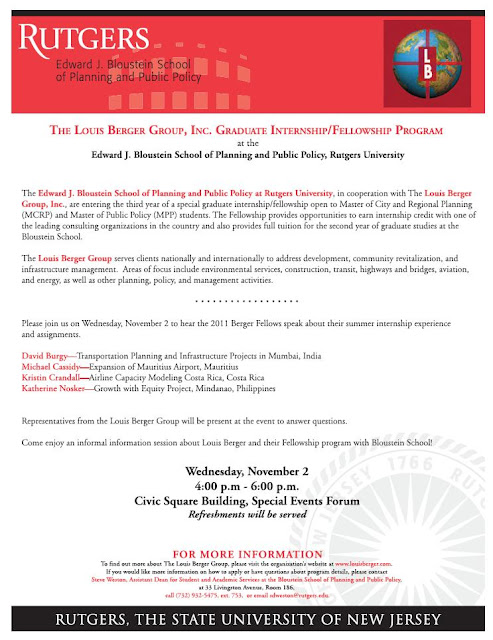
2011 Louis Berger Group Fellows Share their Experience
Please come out Wednesday afternoon to the Special Events Forum at Bloustein to hear four of your fellow MCRP/MPP students share their experiences during the summer of 2011 as Louis Berger Group fellows working internationally on pressing planning and policy issues.
If you are interested in applying to be one of the 2012 Berger Fellows, this is the perfect chance to network and learn more about what the experience is actually like. If not, it is a great chance to revel in your classmates' exciting travels and get some FREE FOOD.
The students presenting and their project titles are:
If you are interested in applying to be one of the 2012 Berger Fellows, this is the perfect chance to network and learn more about what the experience is actually like. If not, it is a great chance to revel in your classmates' exciting travels and get some FREE FOOD.
The students presenting and their project titles are:
- David Burgy, MCRP '12 - "Transportation Planning and Infrastructure Projects" - Mumbai, India
- Michael Cassidy, MCRP '12 - "Expansion of Mauritius Airport" - Mauritius
- Kristin Crandall, MPP/MCRP '12 - "Airline Capacity Modeling" - Costa Rica
- Katherine Nosker, MCRP '12 - "Growth with Equity Project" - Mindanao, Phillipines

Wednesday, October 26, 2011
Plethora of Opportunities
I know we are just getting past fall semester mid-terms but yes... it is already time to think about selecting courses for next semester because registeration starts Sunday, November 6th. Thankfully, with all of the amazing-sounding offerings, this should be a pleasant task. Now is your chance to branch out and think beyond the box (i.e. core classes) and think about taking seminars and studios that pique your interest.
Seminars usually require more reading and more writing but give you the opportunity to think more critically about one specific topic that interests you. Studios are required but are also fantastic because they involve hands-on and technical work while working as a planning team and applying your expertise (or figuring out what it is). If these studios are half as exciting as their short titles make them sound they should be great. I just wish I could take more than two!
Spring 2012 Seminars in Urban Planning and Public Policy
Seminars usually require more reading and more writing but give you the opportunity to think more critically about one specific topic that interests you. Studios are required but are also fantastic because they involve hands-on and technical work while working as a planning team and applying your expertise (or figuring out what it is). If these studios are half as exciting as their short titles make them sound they should be great. I just wish I could take more than two!
Spring 2012 Seminars in Urban Planning and Public Policy
- Development Preservation of Large Cities
- Art and City Design
- Mental Health Policy
- Public Policy Finance
- Planning and Land Use Administration
- Green Buildings
- Integrated Energy Challenges and Opportunities
- Appraisal, Analysis and Real Estate Pro-Formas
- LEED Housing
- Public Policy Budgeting
- Green Economic Policies Worldwide
- Transportation Security
- Writing for Professionals
- Safe Routes to School
- Urban Trnsit
- Easton Avenue Redevelopment
- Visioning the Future Raritan Part II
- Innovations in Community Economic Development
- The New River Agenda
Sunday, October 9, 2011
Where the Sidewalk Doesn't End
by Besty Harvey, MCRP '12
The road that ran past his house led into town. Running up that hill he would pass a white clapboard congregational church. He’d recall the Christmas services there – walking with his children on all those cold Christmas Eves – and as they would enter the church he would look up at the stars and thank God. He wasn’t sure that he believed in God, but on such a night – well, he felt blessed.
There was a small coffee shop on Main Street, too. He used to liked to sit next to the window that looked out on the street full of people and correct his students’ papers or develop the next week’s curriculum. And he would slowly pad along the sidewalk by the coffee shop, wondering what the students sitting by the window thought of an aging man jogging by.
His head would tilt toward the pavement, especially as he ran up hills. He’d watch his feet and count to the rhythm. “One . . . two . . . one . . . two.” They were the same words he’d forced himself to repeat in his head as he’d struggled along the lonely, forested road that wound through Acadia National Park. That had been his first marathon. When he ran his mind would sometimes be drawn back into the cavernous darkness when he’d thought the pain could not get worse.
But then he’d remember the finish – his children cheering for him even though he had finished in the back. And he’d pick up his pace just slightly.
He would pause at an intersection. A car would stop and wave him through. People are so nice here, he’d think. He would miss that.
Maine will be nice, he’d try to reason, but running will be difficult. The sidewalks would be fewer and drivers faster in the countryside.
He would run passed the university, its red brick colonial-style buildings graced with sweeping green lawns. Students would be out playing Frisbee or leaning against a tree, reading. He might see the red-tailed hawk that lived near the library. He would miss this beauty. But he knew that homes changed. It had to happen. The house had to be sold.
But some things wouldn’t change. Roads would still be there, open to him. Beckoning to him to run off his pain, to embrace this life.
Just past the university the sidewalk ended. The speed limit increased to 35 as it passed the agriculture school. He would cross the road so that he would face traffic.
After what seemed like no time at all, he would approach the apple orchard. When the children were little he and his wife would take their children to ride in the horse-drawn hay wagons and pick McIntoshes and Cortlands and Honey Crisps. The kids would run about, investigating wormy apples and petting goats and sheep.
He would sometimes wished he didn’t remember all of these things. But they were good times, he’d remind himself, and he was lucky. Time went on, always.
The road continued onwards; it wound continuously so he couldn’t see what was around the bend. Though he’d run this way so many times before, he liked to imagine he was exploring the route for the first time. He stayed alert to the wind’s direction, the color of the maple leaves, the make of the cars that went by.
The sidewalk came back again as he entered town. He was tired – ready for the run to end – but his mind felt clearer. His life might change, but his run would not. The roads were his.
Friday, September 23, 2011
Walking Out of the Box
by Besty Harvey, MCRP '12
I was lucky growing up. My family lived in the center of a small town, so most of our amenities were within walking distance, including the middle school and high school. If we cut through the woodland behind our house it was a fifteen minute walk; twenty, if we walked on the road.
We lived right outside the one-mile cutoff for children who were allowed to be bussed, but walking was faster. I could leave at 7:20 and get to school on time. But the bus stopped at the end of our street at 7:00. That was an unconscionable trade-off. At the end of the day, walkers were dismissed first, so if I walked quickly I could get home before some of my bus-riding classmates even left school.
“Your mom and I worried about you kids,” my dad told me years later, after I had graduated from college.
Especially me. I was the only girl.
Sometimes I walked with one of my three brothers. But our varying ages and diverse after-school activities meant that I often walked alone, particularly in high school. Track and cross-country practices could end after six, which meant in the winter I would walk home in the dark.
I never felt afraid. Many other families’ children walked to school, and a few even biked. Until they were allowed to drive, every one of the fourteen children on our street walked to school most of the time. The exception was bad weather. The spring rains that drenched New Hampshire led my brothers and I to beg our dad to drop us off at school on his way to work.
But we never asked out of fear. Of the dark, of strangers, of being abducted, of getting lost. Our parents hid theirs so that we wouldn’t have any. They wanted us to have a childhood. They wanted us to discover for ourselves how to navigate in the world, to discover the beauty and the horrors, and to make mistakes. They didn’t allow us to live in a safe box where they could monitor our every movement. We couldn’t learn that way, we couldn’t grow up to be healthy, aware adults. For a box has no roads to travel, and no way to understand why you might want to walk down one in the first place.
I was lucky growing up. My family lived in the center of a small town, so most of our amenities were within walking distance, including the middle school and high school. If we cut through the woodland behind our house it was a fifteen minute walk; twenty, if we walked on the road.
We lived right outside the one-mile cutoff for children who were allowed to be bussed, but walking was faster. I could leave at 7:20 and get to school on time. But the bus stopped at the end of our street at 7:00. That was an unconscionable trade-off. At the end of the day, walkers were dismissed first, so if I walked quickly I could get home before some of my bus-riding classmates even left school.
“Your mom and I worried about you kids,” my dad told me years later, after I had graduated from college.
Especially me. I was the only girl.
Sometimes I walked with one of my three brothers. But our varying ages and diverse after-school activities meant that I often walked alone, particularly in high school. Track and cross-country practices could end after six, which meant in the winter I would walk home in the dark.
I never felt afraid. Many other families’ children walked to school, and a few even biked. Until they were allowed to drive, every one of the fourteen children on our street walked to school most of the time. The exception was bad weather. The spring rains that drenched New Hampshire led my brothers and I to beg our dad to drop us off at school on his way to work.
But we never asked out of fear. Of the dark, of strangers, of being abducted, of getting lost. Our parents hid theirs so that we wouldn’t have any. They wanted us to have a childhood. They wanted us to discover for ourselves how to navigate in the world, to discover the beauty and the horrors, and to make mistakes. They didn’t allow us to live in a safe box where they could monitor our every movement. We couldn’t learn that way, we couldn’t grow up to be healthy, aware adults. For a box has no roads to travel, and no way to understand why you might want to walk down one in the first place.
Sunday, September 11, 2011
Appreciating an Underdog
by Betsy Harvey, MCRP '12
I for one am glad to not be taking Rutgers buses to and from class and work anymore. Last year, in the winter or the pouring rain, when I couldn’t muster the courage to bike, I boarded the bus from my stop on Douglass Campus. The digital displays saying when the next bus would arrive could be between 5 and 15 minutes from what the Rutgers website said, a real problem when class started in 20 minutes. People threw up on the bus on weekend nights. And I quickly learned that using the bus between 4:00 pm and 7:00 pm would mean that the ride would take twice as long. There were times when it would have been quicker for me to walk home. The supposed convenience factor was clearly lacking.
Buses get a bad rap. As the Rutgers bus system often proves, they get you where you want to go, but not necessarily when they say they will or when you need to be there, and certainly not in style. I avoid them if I can afford to. And yet they are vital to many people’s ability to get to work or to the store or to visit friends. For those who cannot afford a car - or who choose not to have one - buses provide essential mobility. As I wrote in an earlier post, mobility is vital to a health economy. It is well worth the investment.
So while I am pleased to be able to walk the ten minutes to school this year instead of taking a half-hour to wait for and ride the bus, I won’t underestimate the importance of affordable bus service. Without it, there would be a serious drain on our already ailing economy and set struggling families back further.
I for one am glad to not be taking Rutgers buses to and from class and work anymore. Last year, in the winter or the pouring rain, when I couldn’t muster the courage to bike, I boarded the bus from my stop on Douglass Campus. The digital displays saying when the next bus would arrive could be between 5 and 15 minutes from what the Rutgers website said, a real problem when class started in 20 minutes. People threw up on the bus on weekend nights. And I quickly learned that using the bus between 4:00 pm and 7:00 pm would mean that the ride would take twice as long. There were times when it would have been quicker for me to walk home. The supposed convenience factor was clearly lacking.
Buses get a bad rap. As the Rutgers bus system often proves, they get you where you want to go, but not necessarily when they say they will or when you need to be there, and certainly not in style. I avoid them if I can afford to. And yet they are vital to many people’s ability to get to work or to the store or to visit friends. For those who cannot afford a car - or who choose not to have one - buses provide essential mobility. As I wrote in an earlier post, mobility is vital to a health economy. It is well worth the investment.
So while I am pleased to be able to walk the ten minutes to school this year instead of taking a half-hour to wait for and ride the bus, I won’t underestimate the importance of affordable bus service. Without it, there would be a serious drain on our already ailing economy and set struggling families back further.
Subscribe to:
Posts (Atom)