My newest obsession... The High Line Park in New York City. The site's sustainable design paired with its spectacular position - four stories off the ground and within an arm's reach of historic and modern buidlings alike - make it one of the most unique urban spaces I have seen yet in my travels. It is just too bad that they do not [currently] allow dogs on the High Line. Because, you know what goes best paired with adaptive reuse, infill development, industrial ecology and urban stormwater management... dogs. But my obsession with dogs is what my other blog is about, so back to stormwater.
 |
| The boardwalk planks (in some sections wood, in others cement) seemlessly disappear into the vegetated sections, emulating both the flow of stormwater runoff on the site and the former linear tracks (some of which can still be found integrated into the landscape). |
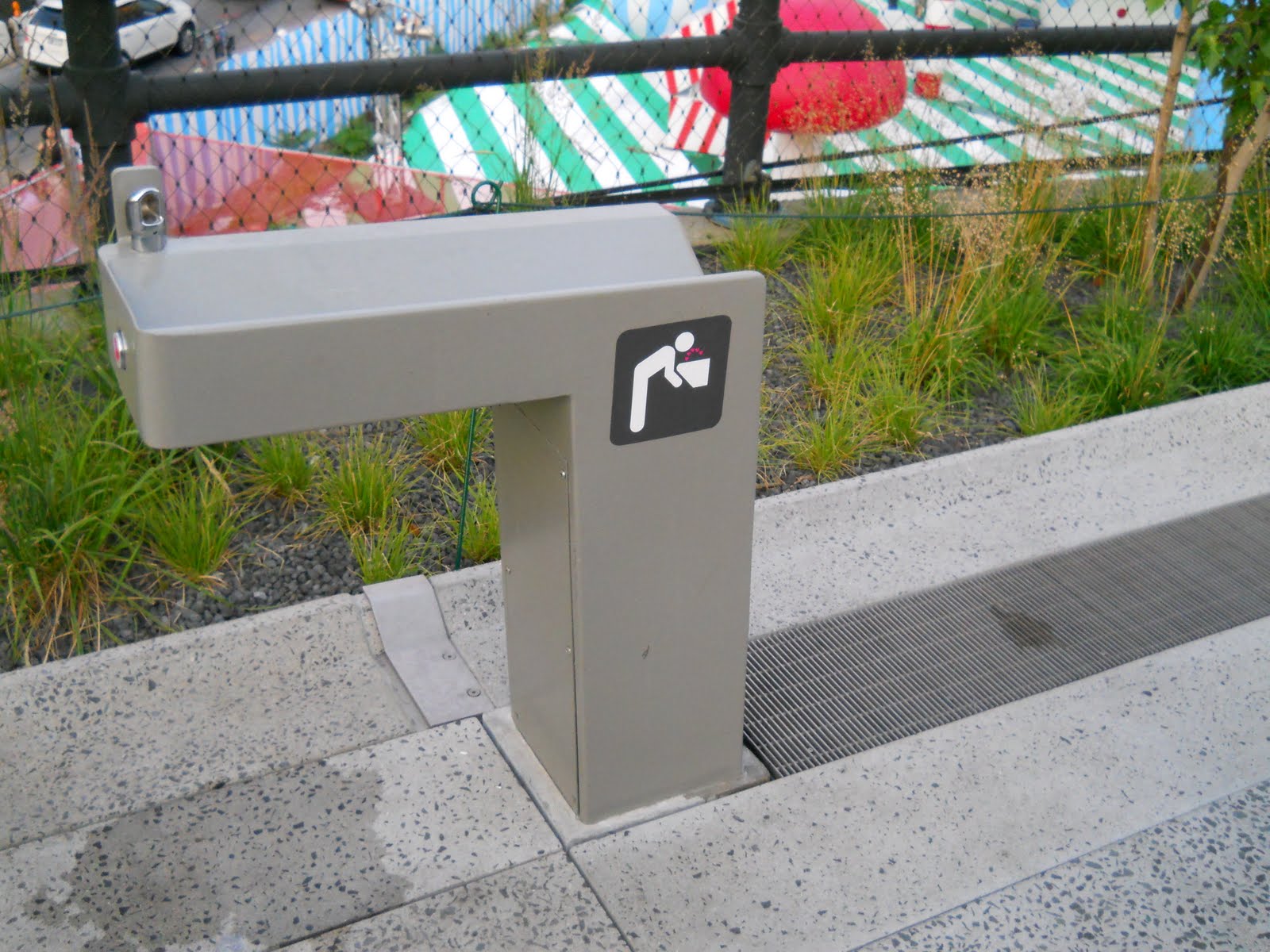 |
| Can't catch all of the water coming out of the water fountain? That's OK. These designers thought of everything. The excess fountain water bypasses any type of hidden drain and simply trickles back into the ground and feeds the adjacent vegetation. |
I have been slowly leading up to the unveiling of the fact that stormwater management can be such a seamless and creative component of any new urban development [or redevelopment]. When one thinks in terms of - not what the fifty-year code tells you is standard - but in terms of what Mother Nature would do - you can create spectacular green spaces that manage stormwater, revitalize communities and provide enriching public gathering spaces.
The High Line Park is a breath-taking example of how stretching your imagination and designing holisticly with preservation (rather than destruction) as your starting point can result in so many other benefits to the community as a whole. Coined "the world's longest green roof;" at its heart, the High Line essentially functions as a green roof. "The High Line landscape functions essentially like a green roof; porous pathways contain open joints, so water can drain between planks and water adjacent planting beds, cutting down on the amount of storm-water than runs off the site into the sewer system." (High Line Park FAQs)
In just twelve years since the first community group to save and rehabilitate the High Line was established, a beautiful, sustainable gem of a park has been created and (as Mayor Bloomberg declared just before Section 2 opened) "preserving the High Line as a public park revitalized a swath of the city and generated $2 billion in private investment surrounding the park." (New York Times) Just one little green roof can do all that? I'm not saying the stormwater management aspects of the High Line are the only reason it has flourished and jumpstarted such immense reinvestment in the surrounding district -but it hasn't hurt either. Because the High Line was so meticulously designed to be sustainable (especially in terms of water use), making it more affordable to operate, it is guaranteed to be around for years and years to come.
What's next? Similar viaduct parks in St. Louis, Philadelphia, Jersey City, Chicago, and Rotterdam? Any thing seems possible with a model like this to follow!


