by Marley Bice, MCRP '12
Park(ing) Day is Friday September 16th year. What started with a 2-hour demonstration in San Francisco in 2005 has grown into an International movement with 850 parks in 30 countries in 2010. The idea is to take over a metered parking space for a day and turn it into a public park showing how much change can come out of a small area of land and also demonstrate that our streets and parking spaces can be redesigned to be more efficient, safe and green.
Although this doesn't immediately scream "green stormwater management" since we are not proposing to rip out the concrete and asphalt, we are making a statement about the way people interact in public spaces and streets and how green elements can make those interactions and spaces safer and more enjoyable. In my opinion, stormwater management starts with creating a connection to public open space and realizing that decreaseing impervious area creates more opportunities for communities to use excess space for beneficial uses. What is the point of putting a stormwater street tree trench or a rain garden where no one is going to see it?
Some cities are starting to recognize the community development and environmental benefits of parklets, often citing the stormwater benefits with the power of the community force behind this movement for safer streets and more public open space. Collaborating with local artists and architects also makes these parklets icons of public art and can help revitalize a neighborhood. Check out these examples:
Philadelphia's First Parklet: http://planphilly.com/philly-first-university-city-gets-parklet
San Francisoco's Pavement to Parks Program: http://sfpavementtoparks.sfplanning.org/index.htm
This year, Bloustein students led by RAPPS and Walk Bloustein/Bike Bloustein are creating a parklet in New Brunswick. To get involved in this world-wide urban revitalization movement, come to an interest meeting in the Bloustein Student Lounge Wednesday September 7th at 4 pm.
Showing posts with label Stormwater Tuesdays. Show all posts
Tuesday, September 6, 2011
Wednesday, August 31, 2011
Green TV and the Power of Irene
by Marley Bice, MCRP '12
I recently discovered that the Philadelphia Water Department has partnered with Green Treks Network to make a series of amazing mini-documentaries on their innovative green stormwater management program, Green City, Clean Waters. One of the things I love about green stormwater infrastructure is that it is so pretty to look at. It really is easy... and beautiful... being green.
Green City, Clean Waters Promo from GreenTreks Network on Vimeo.
Of course any kind of stormwater infrastructure can't prevent all flooding and runoff. Hurricane Irene dropped eight inches of rain on New Jersey last weekend causing the low-lying regions around the Raritan River to flood badly causing murky water to block one of the state's busiest east-west connectors (Route 18). These pictures capture some of the damage.
I recently discovered that the Philadelphia Water Department has partnered with Green Treks Network to make a series of amazing mini-documentaries on their innovative green stormwater management program, Green City, Clean Waters. One of the things I love about green stormwater infrastructure is that it is so pretty to look at. It really is easy... and beautiful... being green.
Green City, Clean Waters Promo from GreenTreks Network on Vimeo.
Of course any kind of stormwater infrastructure can't prevent all flooding and runoff. Hurricane Irene dropped eight inches of rain on New Jersey last weekend causing the low-lying regions around the Raritan River to flood badly causing murky water to block one of the state's busiest east-west connectors (Route 18). These pictures capture some of the damage.
Tuesday, August 23, 2011
My Ten Favorite SMPs
by Marley Bice, MCRP '12
SMP = Stormwater Management Practice
noun (ess-emm-pee) meaning any man-made structure that is designed or constructed to convey, store or otherwise control stormwater runoff, quality, rate or quantity
Now how many of those can there be? A lot! But I have ten favorite ones and here's why:
SMP = Stormwater Management Practice
noun (ess-emm-pee) meaning any man-made structure that is designed or constructed to convey, store or otherwise control stormwater runoff, quality, rate or quantity
Now how many of those can there be? A lot! But I have ten favorite ones and here's why:
- GREEN ROOFS: because they create public space, wildlife habitat, decrease HVAC costs, extend the life of the roof and manage stormwater (why not!?)
- PERMEABLE PAVERS: because they are versatile and attractive
- SWALES: because there are so many applications that bring stormwater conveyance to the surface and increase public awareness of stormwater management issues
- RAINFALL CAPTURE AND REUSE features can also be used to create sustainable water features
- FLOW-THROUGH PLANTERS: because there are so many different options and they are applicable to urban, space-constrained sites
- BERMS AND RETENTIVE GRADING: because this techniques uses attractive landscaping and topography to manage stormwater and decrease erosion
- FILTER STRIPS: because they offer pretreatment benefits without taking up much space
- BUMPOUTS: because they can also calm traffic and increase pedestrian safety
- STREET EDGE ALTERNATIVES such as curbless streets and bioretention swales are a great way to beautify residential neighborhoods
- PAVEMENT DISCONNECT: because it increases infiltration on-site and creates opportunities for use of salvaged materials in the landscaping
Wednesday, August 10, 2011
Bird's Eye View Critique: Houston's Stormwater Sewer System
by Marley Bice, MCRP '12
I've written about combined sewer systems in America's older cities but what about newer cities that were built around separate sewer systems? Are they any better? I've chosen to look at Houston, Texas. Houston was a historic city that experienced significant growth in the 20th century and is now the fourth largest city in the United States. Houston's severe flooding problem is not a huge suprise:
(1) the city is built on a flood plain
(2) the city's landscpae is overwhelmingly short grasses in compact soils
(3) the city chose to increase impervious surfaces and focus on conveyand as stormwater management techniques
I'm not saying I have a solution (or that green stormwater infrastrucutre would solve all of Houston's drainage and flooding problems - undoubtedly not) or that I would have made better decisions myself given knowledge at the time these systems were considered. I'm just saying... take a look at these images from Bing Maps and tell me what you would recommend.
When formulating your recommendations, there are many constraints to consider:
(1) Houston needs to preserve the neighborhoods that have developed around these bayous, so some sort of controlled water's edge needs to be maintained
(2) Consider improving aesthetics and safety around the bayous
(3) Consider how to capture and treat more of the runoff before it reaches the bayous
My major questions: Why was it necessary to purposefully make your catch basin entirely impervious? Why was it necessary to drain that forested area? Why was it necessary to funnel that natural stream into the cement bayou?
I've written about combined sewer systems in America's older cities but what about newer cities that were built around separate sewer systems? Are they any better? I've chosen to look at Houston, Texas. Houston was a historic city that experienced significant growth in the 20th century and is now the fourth largest city in the United States. Houston's severe flooding problem is not a huge suprise:
(1) the city is built on a flood plain
(2) the city's landscpae is overwhelmingly short grasses in compact soils
(3) the city chose to increase impervious surfaces and focus on conveyand as stormwater management techniques
I'm not saying I have a solution (or that green stormwater infrastrucutre would solve all of Houston's drainage and flooding problems - undoubtedly not) or that I would have made better decisions myself given knowledge at the time these systems were considered. I'm just saying... take a look at these images from Bing Maps and tell me what you would recommend.
When formulating your recommendations, there are many constraints to consider:
(1) Houston needs to preserve the neighborhoods that have developed around these bayous, so some sort of controlled water's edge needs to be maintained
(2) Consider improving aesthetics and safety around the bayous
(3) Consider how to capture and treat more of the runoff before it reaches the bayous
My major questions: Why was it necessary to purposefully make your catch basin entirely impervious? Why was it necessary to drain that forested area? Why was it necessary to funnel that natural stream into the cement bayou?
Tuesday, August 2, 2011
Obsessed: The High Line Park
by Marley Bice, MCRP '12
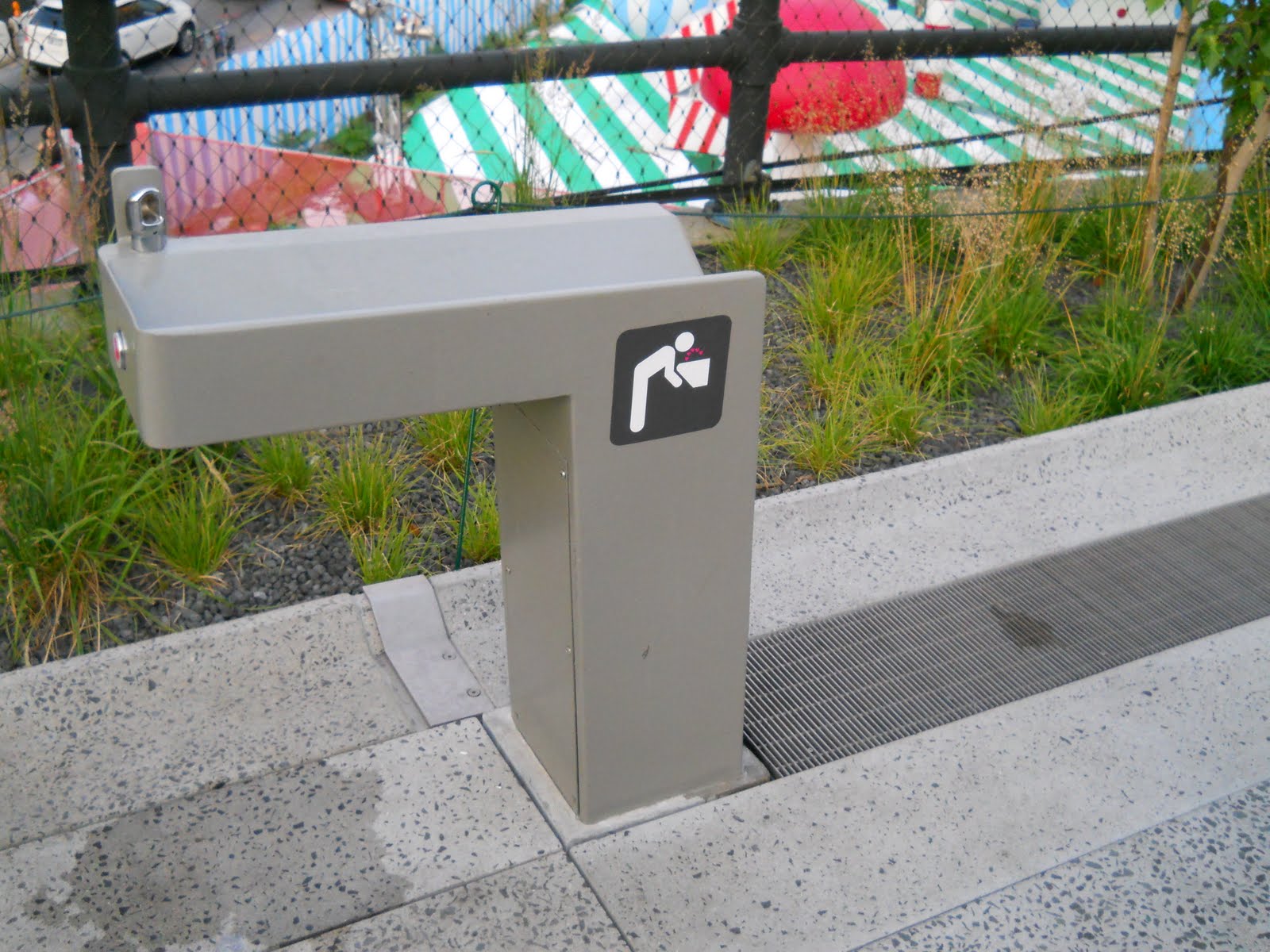
My newest obsession... The High Line Park in New York City. The site's sustainable design paired with its spectacular position - four stories off the ground and within an arm's reach of historic and modern buidlings alike - make it one of the most unique urban spaces I have seen yet in my travels. It is just too bad that they do not [currently] allow dogs on the High Line. Because, you know what goes best paired with adaptive reuse, infill development, industrial ecology and urban stormwater management... dogs. But my obsession with dogs is what my other blog is about, so back to stormwater.
I have been slowly leading up to the unveiling of the fact that stormwater management can be such a seamless and creative component of any new urban development [or redevelopment]. When one thinks in terms of - not what the fifty-year code tells you is standard - but in terms of what Mother Nature would do - you can create spectacular green spaces that manage stormwater, revitalize communities and provide enriching public gathering spaces.
The High Line Park is a breath-taking example of how stretching your imagination and designing holisticly with preservation (rather than destruction) as your starting point can result in so many other benefits to the community as a whole. Coined "the world's longest green roof;" at its heart, the High Line essentially functions as a green roof. "The High Line landscape functions essentially like a green roof; porous pathways contain open joints, so water can drain between planks and water adjacent planting beds, cutting down on the amount of storm-water than runs off the site into the sewer system." (High Line Park FAQs)
In just twelve years since the first community group to save and rehabilitate the High Line was established, a beautiful, sustainable gem of a park has been created and (as Mayor Bloomberg declared just before Section 2 opened) "preserving the High Line as a public park revitalized a swath of the city and generated $2 billion in private investment surrounding the park." (New York Times) Just one little green roof can do all that? I'm not saying the stormwater management aspects of the High Line are the only reason it has flourished and jumpstarted such immense reinvestment in the surrounding district -but it hasn't hurt either. Because the High Line was so meticulously designed to be sustainable (especially in terms of water use), making it more affordable to operate, it is guaranteed to be around for years and years to come.
What's next? Similar viaduct parks in St. Louis, Philadelphia, Jersey City, Chicago, and Rotterdam? Any thing seems possible with a model like this to follow!
My newest obsession... The High Line Park in New York City. The site's sustainable design paired with its spectacular position - four stories off the ground and within an arm's reach of historic and modern buidlings alike - make it one of the most unique urban spaces I have seen yet in my travels. It is just too bad that they do not [currently] allow dogs on the High Line. Because, you know what goes best paired with adaptive reuse, infill development, industrial ecology and urban stormwater management... dogs. But my obsession with dogs is what my other blog is about, so back to stormwater.
I have been slowly leading up to the unveiling of the fact that stormwater management can be such a seamless and creative component of any new urban development [or redevelopment]. When one thinks in terms of - not what the fifty-year code tells you is standard - but in terms of what Mother Nature would do - you can create spectacular green spaces that manage stormwater, revitalize communities and provide enriching public gathering spaces.
The High Line Park is a breath-taking example of how stretching your imagination and designing holisticly with preservation (rather than destruction) as your starting point can result in so many other benefits to the community as a whole. Coined "the world's longest green roof;" at its heart, the High Line essentially functions as a green roof. "The High Line landscape functions essentially like a green roof; porous pathways contain open joints, so water can drain between planks and water adjacent planting beds, cutting down on the amount of storm-water than runs off the site into the sewer system." (High Line Park FAQs)
In just twelve years since the first community group to save and rehabilitate the High Line was established, a beautiful, sustainable gem of a park has been created and (as Mayor Bloomberg declared just before Section 2 opened) "preserving the High Line as a public park revitalized a swath of the city and generated $2 billion in private investment surrounding the park." (New York Times) Just one little green roof can do all that? I'm not saying the stormwater management aspects of the High Line are the only reason it has flourished and jumpstarted such immense reinvestment in the surrounding district -but it hasn't hurt either. Because the High Line was so meticulously designed to be sustainable (especially in terms of water use), making it more affordable to operate, it is guaranteed to be around for years and years to come.
What's next? Similar viaduct parks in St. Louis, Philadelphia, Jersey City, Chicago, and Rotterdam? Any thing seems possible with a model like this to follow!
Tuesday, July 26, 2011
What Lies Beneath
by Marley Bice, MCRP '12
In light of the recent fire at New York City’s North River Sewage Treatment Plant which caused plant operations to cease for almost 48 hours and 360 million gallons of untreated wastewater to flow into the Hudson River, I hope people are starting to think more critically about what happens when it rains on the local Wal-Mart parking lot or what happens when you flush your toilet. In combined sewer system cities across the country, including New York City and Philadelphia, that rain water and waste water are funneled into the same pipe. In dry weather, the combined waters flow directly to the local water pollution control plant and all we have to worry about his how well that plant can actually clean that water and how much electricity it takes to run the plant. However, in wet weather (or when a fire outbreak causes plant operations to cease) this toxic mixture cannot be contained by the combined sewer system and the excess is piped directly into the local water body.
The alternative that cities that have developed more recently have implemented is a separate sewer system. In this system the stormwater and the wastewater are piped into separate systems so that sewage is always sent to the water pollution control plant and stormwater is always sent straight to the river. Unfortunately, it is a lose-lose situation. In dry weather, the combined system is better because it ensures that both forms of polluted water are treated. However, on average throughout the year, a separate sewer system is better because it prevents the most obnoxious and toxic forms of waste to always be treated.
In my opinion any sewer system of grey infrastructure needs to be combined with innovative green stormwater infrastructure that minimizes the amount of rain water that is sent to the sewer system. With our current technologies and knowledge, we are able to treat a large amount of stormwater with infiltration systems and strategic vegetation such as green roofs and rain gardens. Hopefully some day we will have similar sustainable methods of treating our sewage wastewater as well.
What can we do today? Decrease surface parking lots, increase tree canopy, create legislation and crediting systems to encourage private sector implementation of rainwater harvesting and green roofs, and teach our kids to respect the life-sustaining water cycle.
Tuesday, July 19, 2011
Stormwater Tuesdays: Rainwater as Education
by Marley Bice, MCRP '12
Back to describing why stormwater is so fascinating and important. This week I want to gush about how bringing stormwater to the surface (or just keeping it there where it fell) and creating attractive features with the water can help educate us (and the next generation) about the natural water cycle and how manage the urban water cycle. Let’s face it our urban development pattern has caused a physical (and therefore mental) disconnection from our natural water cycle. Do you remember when you first learned about the water cycle? Were you surprised (especially if you lived in the city) to find out that that rain that fell from the sky is supposed to replenish your drinking water and oceans?
The fact of the matter is we have the same amount of water on Earth than we always have but less and less of it is clean enough to support life on our planet. We have diverted and polluted the water we were given so immensely that the only answer is to allow the natural processes of phytoremediation and photosynthesis to try to reduce and reverse the damage that has commenced.
Well, wouldn’t it be great if our kids could grow up in efficiently developed towns and cities and still develop a true understanding and connection to water. Creating green stormwater infrastructure that also serves as an educational tool to illustrate the water cycle at our scale can help achieve this. Check out these examples:
![]() |
| The Dane County Office of Lakes and Watersheds has developed a great curriculum for 6th graders that is best when implemented with the school’s implementation of a stormwater management system such as rainwater harvesting or a rain garden. Let the kids learn about the problem and then implement part of the solution. http://www.danewaters.com/pdf/stormWaterCurriculum.pdf |
![]() |
When feasible, it is great to combine rainwater harvesting with a creative viaduct feature to maximize the time that the water cycle is visible to passers-by like this great rain garden and cistern at Syme Hall at North Carolina State University. http://shiftncsu.wordpress.com/2010/09/02/from-gene-bressler-open-thank-you-letter-to-syme-raingarden-partcipants/ |

![]() |
It could be as easy as including interpretive signage and ensuring public access to the site. But Arlington, Virginia went above and beyond with their Children’s Rain Garden at Powhatan Springs Park. http://www.arlingtonva.us/departments/ParksRecreation/scripts/planning/powhatan/ParksRecreationScripts PowhatanRainGarden.aspx |
Tuesday, July 12, 2011
Stormwater Tuesdays: You Design It!
by Marley Bice, MCRP '12
I have so much more I could tell you about why we need to manage stormwawter sustainably (rainwater as art... rainwater as an educational opportunity... rainwater as an important resource...) but I stumbled on a great case study of green stormwater infrastructure so I am going to dive right into the first case study for this series.
MAPLEWOOD, MINNESOTA
Maplewood is a small town of 38,000 with a big passion for rain gardens; so much so that they have established a program to implement as many rain gardens as possible whenever there is a city street reconstruction project. Each year the City comes up with about ten new rain garden designs that land owners adjacent to the streets projects can select from. The designs are all different sizes and shapes and color combinations... even great names like "Butterfly and Friends Garden" or "Cool Whites and Jazz Brights Garden." And if that isn't enough to prove that they must be doing something right; just look at the numbers. Maplewood now has over 620 rain gardens with 60 of those on city-owned property.
| What has got great color, a great name and great benefits for stormwater management? The Sunny Border Garden. http://mn-maplewood.civicplus.com/DocumentView.aspx?DID=218 |
YOU DESIGN IT... THEY BUILD IT... YOU MAINTAIN IT...
How much maintenance is required for a rain garden you may ask... especially for a rain garden that is meant to treat road runoff? Rain gardens are designed specifically for your climate zone and water-tolerant plants are placed in the center and upland plants along the permiter of the rain garden. Because the plants are selected for your climate zone's temperature and rainwater averages, once your rain garden is established it won't even need to be watered most of the time. On that note, it is important to remember that rain gardens are designed to infiltratie or evaporate all of the rainwater collected within 24 hours so that mosquitoes are never a problem.
One major contaminant that will end up in your rain garden is fine sediments from the road surface. Gravel and large rocks are often placed at the outfall or entrance to the rain garden to capture the fine sediment in one place where it can be easily cleaned out. Another common contaminant, especially in the winter, is salt. Therefore, salt-resistant plants are identified and selected for rain gardens in areas where salt is a common pollutant in street runoff.
Other property owners are concerned that directing road runoff into a vegetated depression on their property is wrong because the contaminants from the road will hurt their plants. But no need to worry. The whole idea is to slow down the runoff and treat the runoff through the natural phytoremediation (using plants to clean up soil or water) benefits of vegetation and soil. You definitely shouldn't grow food in your rain garden but if designed correctly the plants in your rain garden will be able to withstand the runoff volumes and mild contaminants.
| This diagram explains how the soil filters and breaks down the pollutants from street runoff. http://www.ci.maplewood.mn.us/DocumentView.aspx?DID=246 |
Virginia Tech is in the midst of a study evaluating how well woody plants can be used for phytoremediation of stormwater runoff: http://www.arec.vaes.vt.edu/hampton-roads/research/horticulture/index.html
Colorado State is looking more specifically at aquatic vegetation species that can effectively phytoremediate urban stormwater runoff in constructed wetlands: http://rydberg.biology.colostate.edu/Phytoremediation/2003/Knuth/home.htm
Kentucky City has a great online database of plants where characteristics such as "deer tolerant" and "drought defiant" can be selected to narrow down the best plants for your rain garden: http://www.rainkc.com/index.cfm/fuseaction/plants.search/index.htm
Tuesday, July 5, 2011
Stormwater Tuesdays: Rainwater as Art
by Marley Bice, MCRP '12
Last week I mentioned that rainwater can become art. Usually this takes the form of green stormwater infrastructure such as rain gardens, bioswales, green roofs, green walls, pervious pavers, porous pavement, street trees, stormwater tree trenches, curb cuts, curb bump outs… should I go on? The idea is to let the rain water slow down long enough to soak into the ground (or the vegetation on your green roof). Once water is in the ground it is put back into the natural water cycle and enhances the natural ecosystem so that the built environment has less of a negative impact on our waterways and natural habitats. As an urban planning student with one year of study under my belt I have to admit that a city is the most efficient way for our modern society to live, but there are ways to break down the perceived barrier between our built environment and natural environment especially when it comes to the urban water cycle.
Some green stormwater infrastructure ideas like rain barrels and cisterns actually harvest the rain to be used for irrigation or non-potable uses. This water doesn’t always get back into the water cycle but it still reduces the amount of water that goes straight into the city’s sewer system and decreases pollution in our water ways and erosion of our stream banks. Water really is a resource and we need to remember that and use it wisely whether it comes out of the sky or out of our water faucet.
One of the things most of these green stormwater concepts have in common is that they keep the water visible. Instead of immediately piping the water away from our view like traditional sewer systems, green stormwater infrastructure lets water trickle and settle and infiltrate. This creates great opportunity for education also. By seeing the water cycle in action we become connected to it and develop a water ethic and respect for this scarce resource.
Some people get really creative!
Besides, would you rather see more of this... or this?
Photos: http://goldenbelthistoricdistrict.wordpress.com/ and http://www.mapleleaflife.com/2011/06/07/praise-for-thornton-place-natural-area-from-the-atlantic-magazine/
Tuesday, June 28, 2011
Stormwater Tuesdays: CSO LTCPU… GCCW… BMP… LID
by Marley Bice, MCRP '12
It turns out stormwater management in general and a large city’s water management program website requires its own glossary in order to navigate the myriad of acronyms. I first fell in love with BMPs (best management practices) and LID (low-impact development) as an AmeriCorps member working on watershed outreach in Coastal Oregon but my new internship with CHPlanning and PWD (the Philadelphia Water Department) will help me learn more about IWMPs (Integrated Watershed Management Plans) and SWMMs (Stormwater Management Models) while I work on the City’s GC, CW (Green City, Clean Waters) program and their CSO LTCPU (combined sewer overflow long-term control plan update).
I guess it is important to start with understanding the past of water management and sewer systems in Philadelphia, Pennsylvania, one of the oldest cities in the United States. William Penn’s original plan for Philadelphia included an emphasis on green open space and a city that promoted walkability. Philadelphia quickly grew into a city of industrial and historical renown. The city’s leaders were quick to realize that they needed to protect their drinking water resources. Therefore, Fairmount Park (a total of 9200 acres) was established around the upper Schuylkill River to protect the city’s drinking water resources. Today, Philadelphians are beginning to realize that we need to protect our waters for environmental and recreation reasons as well. It was the Philadelphia Water Department’s recent reevaluation of how the city’s physical infrastructure affects the quality of the surrounding rivers that led to their new green stormwater infrastructure program: Green City, Clean Waters. I am privileged to be working with them at the exciting beginnings of this project.
So, watch this series on The RAPPS Blog for ramblings about making our cities greener by slowing rainwater down and soaking it in. I truly believe rain water is a valuable resource and can also create artwork in the most unexpected ways.
Subscribe to:
Posts (Atom)